

Affiliate Disclosure (click here)
As an Amazon Affiliate I may receive a small compensation for qualifying purchases. It helps keep this information free!
If a car’s engine overheats, it can literally warp the metal and become damaged. On the other hand, when it’s cold, it doesn’t run efficiently. So, it is important to know how to determine if a car’s thermostat is stuck. It’s imperative to your engine integrity to keep the engine at the right temperature, which is where the thermostat comes in.
The coolant in the radiator flows through the engine. When the engine begins to get hot, coolant flows through and absorbs the heat in the metal as it flows through the system. The thermostat regulates the flow of coolant to the engine maintaining an optimal temperature for best performance.
The engine thermostat has an open and closed position. When it’s open, the coolant flows through the entire engine. As it flows through all of the paths in the engine it is lowering the temperature by absorbing the heat from the metal the engine is made of. As the coolant leaves the engine it is hot, from absorbing all of the heat. It is routed to the radiator. The radiator cools the coolant down and routes it back into the engine to start the process over again.
When the thermostat is closed, the coolant is blocked. It is only able to flow in a minimal portion of the engine. Once the engine warms up to operating temperature, the thermostat opens to allow coolant to flow through the entire engine.
Engine manufacturers will install a thermostat that opens at the car’s operating temperature (usually either 180° F (82° C) or 212° F (100° C). While the thermostat controls coolant flow, the radiator’s job is to cool the fluid. The coolant flows through the radiator which cools it, and then it flows back through the engine to absorb the heat again, over and over.
When an engine is cold, the radiator fluid is cold, so the thermostat is in the closed position. In this position, coolant will only flow inside the engine. It will not be able to leave the engine to cycle through the radiator to be cooled until the thermostat begins to open. When the thermostat is in the closed position, the spring in it is extended. The spring compresses as the temperature rises which in turn allows coolant to flow.
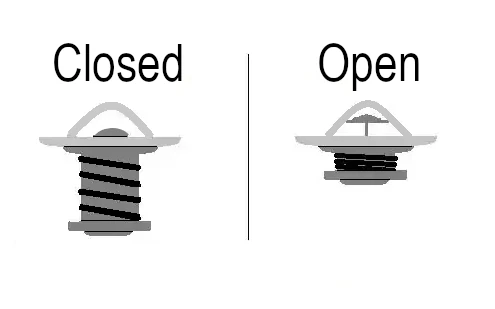
The Thermostat Will Give You Clues It’s Going Bad
- You will notice that the engine is overheating often.
- When you look under the hood the radiator is steaming or bubbling.
- The heater doesn’t warm up inside the cabin of the car, even when the engine has been running for a while. (This could also indicate that the heater core has gone bad).
- The temperature gauge on the dashboard doesn’t rise up to operating temperature, or it rises up quickly to overheating.
There Are Five Procedures To Check If The Thermostat Is Working
| Procedure | Explanation |
|---|---|
| 1. Cold engine test: Open the hood and remove the radiator cap. Start the engine. Observe coolant action by looking down into the radiator where you just removed the cap. The fluid should not be moving…at first. Follow with the next test below. | When an engine is cold, the thermostat should be closed, thus bypassing the radiator. |
| 2. As the engine warms up from the above cold engine test the thermostat should begin to open. Look down into the radiator and observe coolant action. The fluid should be swirling vigorously. | When an engine is warm, the thermostat is in the open position. This allows the coolant to flow through the radiator causing vigorous movement. |
| 3. Cold engine test: Start the engine. Turn on the heater. Time how long it takes the engine to warm up enough for the heater to actually produce heat in the passenger compartment. | If it takes more than five minutes for the heater to produce heat, it is a sign that the thermostat is stuck open, allowing the coolant to detour through the radiator all the time. This causes it to take a good deal longer for the engine to warm up. |
| 4. When the engine is warmed up check for bubbling or hissing at the radiator cap. | If the radiator cap is bubbling or hissing the coolant is overheating causing severe pressure in the radiator. |
Locate The Thermostat
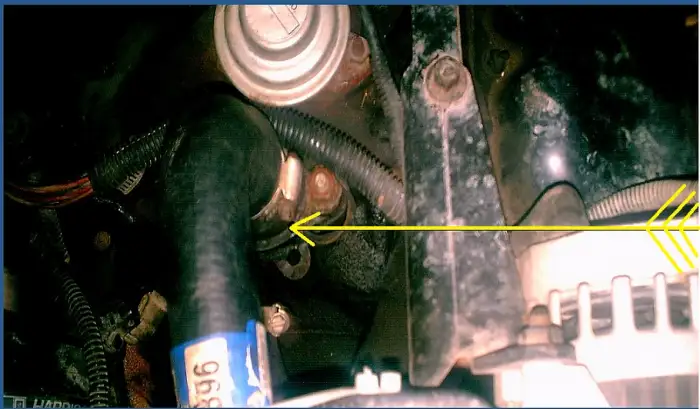
You can find your car’s thermostat by finding the upper radiator hose and following it to where it enters the top of the engine. The thermostat housing is right where the radiator hose meets the engine housing. It looks like half of a metal baseball.
5. Removing And Testing The Thermostat
Follow along with the instructions below and you will definitely know whether the thermostat is stuck.
- Disconnect the negative battery cable.
- Drain some of the coolant (a gallon should be enough) so the fluid won’t pour out when you perform the next step.
- Remove the upper radiator hose.
- Remove the thermostat housing (The baseball looking metal piece that was attached to the radiator hose you removed).
- Remove the thermostat make note of how it is set in the housing (which side is up).
- Locate and record the temperature stamped on the lip of the thermostat.
- Fill a pot with water and place it on the stove.
- Place the thermostat in the water.
- Using a turkey thermometer, or a candy thermometer, place the tip of the thermometer in the water.
- Turn the stove burner onto med/high.
- Watch the thermometer. When the temperature rises to the number you recorded in step #6, the thermostat will start to open. If it does not, or if it doesn’t open until reaching a different temperature (hotter usually), then the thermostat is bad and should be replaced. If it opens at the designated temperature, then the thermostat is just fine.
The thermostat is such a vital component to the well-being of your vehicle, yet it is so cheap. Replacing it is far less costly than repairing a warped engine. A warped engine must be removed and either resurfaced, if the damage isn’t terribly bad, or completely replaced.
And whenever the thermostat housing is removed, even just to check the thermostat, you should at least replace the housing gasket. A housing gasket needs to be able to seal fully, and it won’t if it’s been used.
Sometimes instead of replacing a thermostat, car owners remove it and drive around without it. This is not a good idea, because a cold engine does not function efficiently, and consistently spending long periods warming up your car will take years off of the engine’s life.
Be safe and replace!
Thanks for stopping in!