

The short answer: No, There is no need to put a blanket on a horse unless it is ill, a Thoroughbred, premature foal or a senior. Read more about why.
Updated on March 30, 2023
Updated on January 6, 2026
If you are unsure whether your horse needs a blanket or jacket to keep warm during the Winter, let’s go over some basic facts first. Horses have been evolving on our planet far longer than humans. Eohippus—a small, dog-like creature—was the first to present itself in the horse line. The exact year Eohippus first made its appearance on the stage of the earth is up for argument. Some educated guesses put their appearance at five million years ago. Others say it is closer to ten million years ago. There’s even an estimate of forty million years ago. Obviously, not everyone agrees when Eohippus first made its appearance. We can safely conclude it was long before humans by millions of years.
Winter: Their Coat Is Thick & Fluffy
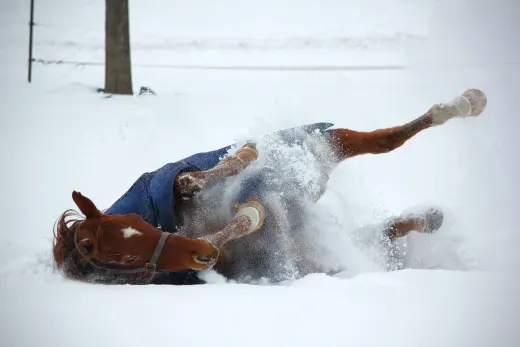
To adapt to the ever-changing seasons, the horse grows a winter coat beginning in the early winter months when the nights begin to get chilly. Their coat is thick and fluffy! On a particularly cold evening, the horse will fluff his hair up on end to retain more heat. On warmer winter days, the horse may roll in the snow to cool off and keep his hair flattened to his body more to allow heat to escape.
Summer: They Shed Their Coat
In the spring, when the weather becomes warmer during the day and the night, their winter coat begins to shed off. There can be a lot of hair sloughing off during this time of shedding. Some horses shed such a thick winter coat it seems like another horse could be made with all the hair on the ground. I’ve watched a horse lie down in an area with just dirt and grass and roll around a couple of times. When he gets up … it looks as though he dropped a fur jacket on the ground, and he did!
Horses will roll on the ground, rub up against trees, fence posts, humans, and just about anything to remove the hair. It is a natural process; they know what they are doing, and they have been doing it for millions of years!
The horse has adapted so well to the ever-changing environment he lives in that he has no needs for human intervention..
The Nature Of The Horse
Are we doing the horse a favor by putting a jacket on him when it is cold outside? No, we are not. We are doing far more damage than any good that could possibly be derived from it. We are doing profound damage to the nature of the horse. The horse has a natural tendency to grow a nice thick, woolly coat during the cold months and slough it off in the Summer. By putting jackets and blankets on a horse confuses his entire system.
When a human puts a blanket on the horse, its natural tendency to grow that thick coat they need to survive winter is inhibited. His body does not recognize the season as winter because they are wearing a blanket; that tells their body, hey, it’s still Summer. Humans are inflicting this confusion with the horse’s natural tendency.
The Exception: Thoroughbreds & Seniors
There are two instances where you will find an exception; Thoroughbred horses and senior horses. The Thoroughbred horse has been systematically altered for speed on the racetrack. And many horses can live into their late senior years, into their thirties, if the Winter is made a little less harsh.
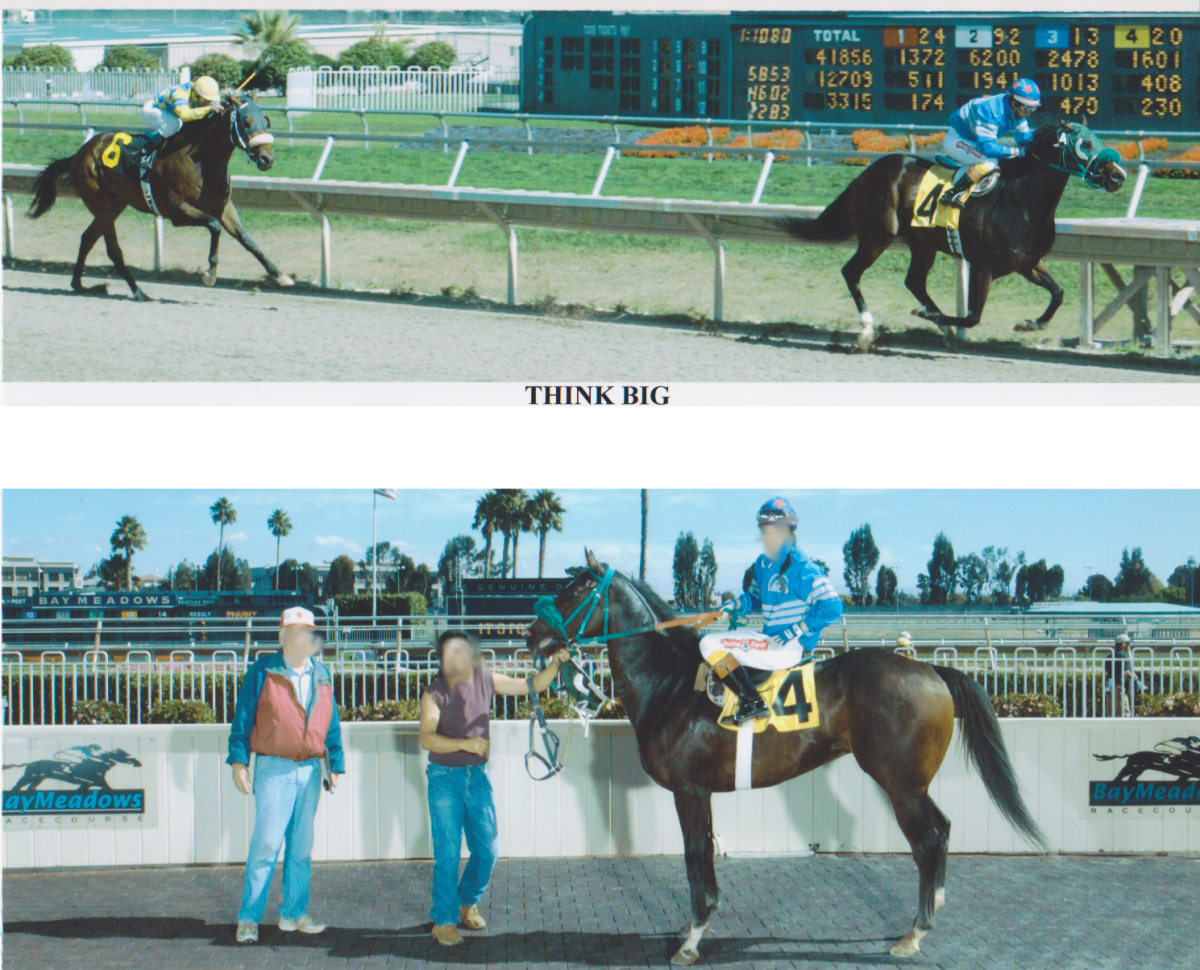
A Perfect Example
Take a look at the Thoroughbred racehorse. When, and if, humans become extinct, the Thoroughbred horse will be the first to become extinct right along with us. Why? The Thoroughbred horse has been bred to inherit specific traits that humans find complementing to our sport of horse racing.
The Thoroughbred horse’s heart is three times the size of any normal horse. This enlarged heart allows the Thoroughbred horse to run faster, sustain its speed longer, and run a further distance without the fatigue a normal horse would experience.
Thoroughbred horses are highly coveted by the horse racing industry. The horse pictured above sold for $80,000 as a yearling. Humans don’t put $80,000 horses out in the pasture! They are kept in stalls of heated barns, and humans intentionally put heavy blankets on them to inhibit the growth of a winter coat. The Thoroughbred has been so altered by humans they could not possibly survive without humans to continue their special care.
When humans and jackets are gone, where will that leave the horse that has become dependent on those jackets? They will be left out in the cold. We need to stop and leave the horse to his own devices that have proven to work perfectly for them for millions of years.
Below are some of the occasions when a jacket for a horse is appropriate:
- An old horse. One thing humans have given to the horse is longevity. When a horse becomes old and can’t grow that coat like he used to, he would normally pass away. But humans provide extra nutrition and a jacket, and this can extend the horse’s life by several years.
- A sick horse. When a horse becomes ill and cannot produce heat as he should to stay alive, he would pass away in nature. Humans provide the temporary warmth he needs and provide medicines in such a way that the horse can pull through an illness.
- A foal. A foal that is premature or has fallen ill, in nature, would pass away. Humans can provide the warmth and medicine to help the foal through this difficult time.
Breeding Out Of Season
Now we are seeing a new problem with humans intervening on horses. Breeding a horse out of season. Horses, when left to their own devices, will not breed at certain times of the year. A foal born in the dead of Winter will not survive. Evolution has ingrained this into the horse.
Humans are forcing horses to breed when they should not for the sake of the foal. Why are humans doing this? Let me explain. Horses generally give birth in the Spring. The weather is conducive to a foal viability, offering the best conditions for survival. Foals grow quickly! By December that foal is only about six months old. Old enough to endure the Winter months coming, but not very tall. yet. Breeders found that if their horse foals in January, by December that foal is nearly a year old! In the show ring a one year old is far more appealing than the six month old foal. The yearling makes the foal look weak, small, scrawny. That will not win in the show ring! So, force breeding the mare to foal in the middle of Winter is prime for horse shows. I say force breeding because the mares are reluctant to breed at this time of year. Their evolution tells them don’t breed at this time of year. Humans intervene and force the breeding. A foal cannot survive being born in the middle of Winter. The foal must have human intervention to survive. The foal must have a blanket.
I Took A Drive In The Country
Today, I took a drive in the countryside. It is November in California. The air is crisp at night but warms up to the seventies during most days. I live in the country, so I didn’t have to drive far before I came upon the first pasture with horses in it. There was a small herd of 5 horses, one lying down trying to enjoy the warm sun, with a jacket on! The other four were standing, resting, with jackets on of various degrees of wear. A couple had what looked like strips of the jacket hanging precariously down to the ground. A sure precursor for tripping the horse.
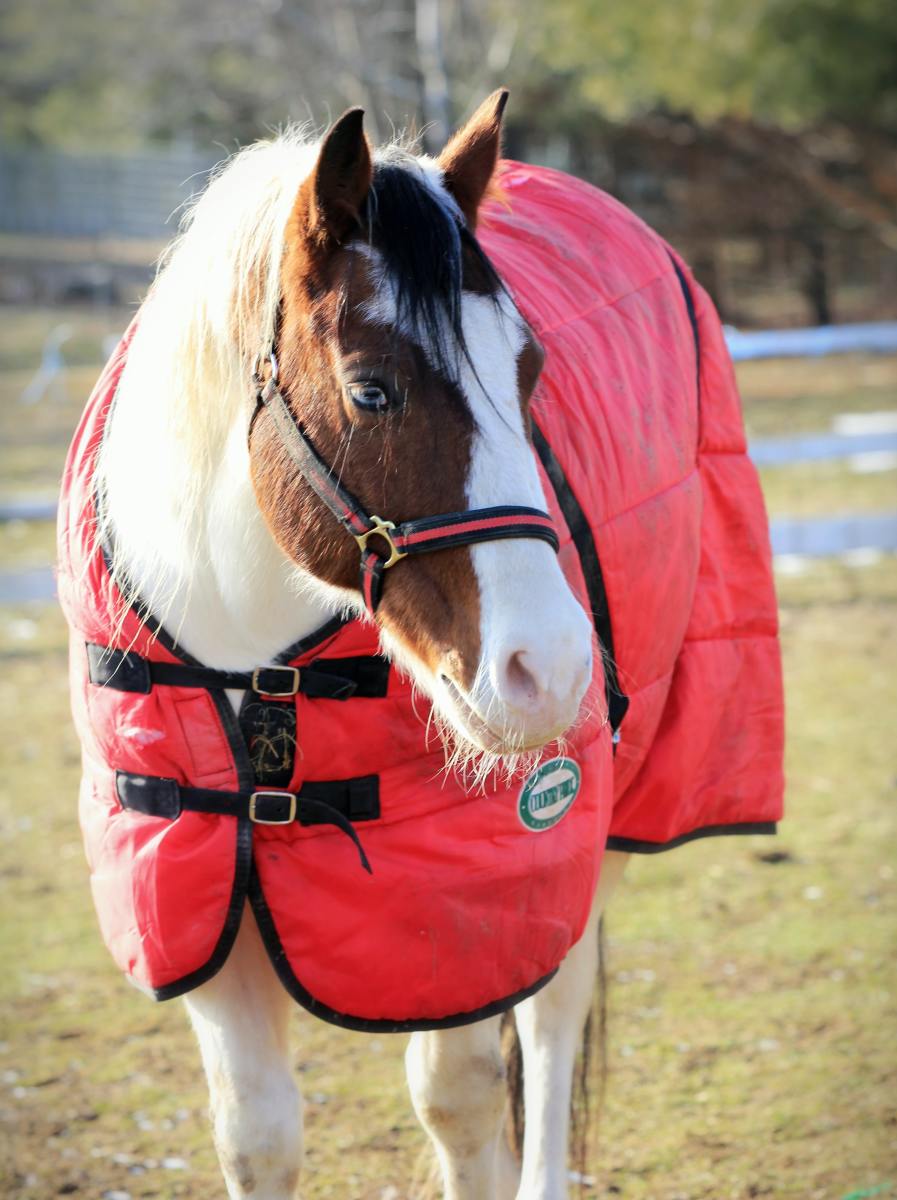
I can imagine it would have felt so good for those horses to lay out on the green grass in the warm sun and enjoy the sunshine on their fur, but none of them could. Instead, they endured the steaming heat their bodies produced inside those jackets. Their hair all mashed down. The sweat from overheating mixing with the heat of the day coming on; it was sad to see.
The less that humans intervene with a species, the better.