
The equestrian world operates on a specialized lexicon—a language that serves as both a tool for precision and a barrier to entry. To step into the stable, the arena, or the field without a command of this terminology is to remain an outsider. Mastering this vocabulary is not merely a suggestion; it is a professional requirement for anyone handling, grooming, or riding a horse.
Even after thirty-five years at the center of this industry, the evolution of equine terminology continues. While the vernacular of tack, gaits, and physiology is vast, the seasoned horseman relies on a foundational understanding of linguistic roots to navigate unfamiliar terms. Most modern labels are simply shorthand or slight derivations of classical identifiers.
The following compendium categorizes the essential terminology required to navigate the equine circle with absolute confidence. While no list is truly exhaustive, these terms constitute the core knowledge necessary to speak—and be heard—within the elite world of the horse.
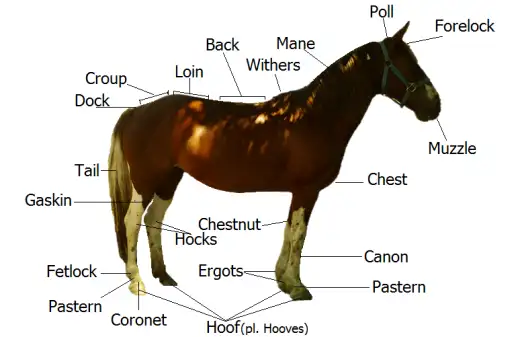
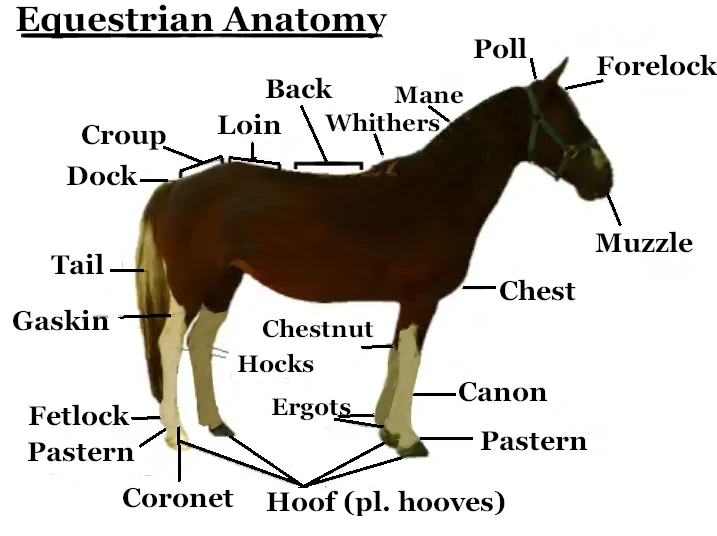
Following this alphabetically ordered list you will find diagrams identifying the location of the terms defined.
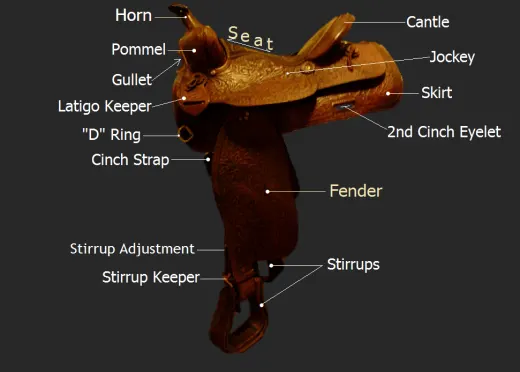
- “D” Ring – This is a metal loop shaped like a “D” that is used for attaching the breast collar to the saddle.
- Action – How the horse is moving his legs, especially trotting.
- At Stud – An intact male horse that can be hired for breeding purposes.
- Balk – When the horse stops and will not move forward on command.
- Barefoot – A horse not wearing shoes. The hoof in the 3rd thumbnail is barefoot.
- Bars – There are two items that are the bars concerning a horse. One concerns the horses mouth. If you look inside a horses mouth, on either side, just inside the check, there is a blank space of gums where no teeth have grown (sometimes a tooth will grow here but it is removed for comfort of the horse). This is where the bit sits when it’s in the horses mouth. This area is referred to as the bars.
- Bars – The other bars refers to the saddle structure. The frame of the saddle is made of metal or rawhide. The bars are the part of the saddle that sits on either side of the ribs. The bars should be well padded. If your horse has strips along his rib cage after you’ve ridden that saddle is no good for him and needs to be replaced.
- Billet/Girth Strap – The thick strap that holds the saddle on the horse.
- Bit – The bit is the metal piece inserted to the horses mouth.
- Bot Fly – A fly that lays white bot eggs on the horses hair (cause of worms)
- Bosal -A bosal (pronounced bo-ZAL) is a specialized, bitless noseband typically crafted from braided rawhide or leather around a stiff rawhide core. It is the defining component of a traditional hackamore (often referred to as a jaquima)
- Bridle – This is the leather piece that goes over the horses head and rests on the poll. It may include a bit, brow band , throat latch, curb chain and reins.
- Brood Mare – A female horse retained for breeding purposes.
- Cantle – The cantle rises behind the rider which provides support and security. The cantle can be of various height depending on the work the saddle will be used for. Pommel is the front side of the seat.
- Cinch Strap – A wide strap attached to the saddle below the jockey used to secure the saddle to the horse by attaching at one side, passing under the horses belly and attaching to the other side.
- Colic – Commonly used for an equine stomach upset that can be deadly.
- Colt – A young, less than one year, male horse.
- Confirmation – This is the look of the horse. The muscling, stance, weight, head position, etc.
- Curb Chain – This is the chain that attaches to the bridle and sits below the chin of the horse.
- Eyelet – This is a reinforced hole—typically lined with a metal or plastic ring—integrated into the leather or synthetic components of a saddle. Eyelets are strategically placed to allow for the attachment of additional gear.
- Fender – On a saddle this is the wide piece of leather that protects the riders legs from the cinch and cinch parts. Usually highly decorated with intricate designs and sometimes silver.
- Filly – A filly is a young female horse, usually under one year of age.
- Foal – A young horse, usually under 1 year, of either sex.
- Gait – WALK, TROT,CANTER, LOPE, GALLOP
- Gelding – A male horse that has had his testicles removed.
- Ground Work – Before stepping into the saddle of a young horse you need to train them for basic behavior. You are on the ground, not in the saddle. This is your ground work.
- Gullet – The arched area at the front of the saddle where the horses backbone is allowed to pass through
- Hand – This is a measurement. unit used for measuring a horse. 1hand = 4 inches
- Headstall – The piece of leather that goes on the head of the horse over the poll. There is no bit, or reins included when your talking about the headstall.
- Horn – A knob coming out of the pommel very much like a boat cleat except the top is not a large “T” it’s more of an upside down “L” formation. The horn is for roping cattle so the cowboy/cowgirl is pulled out of the saddle when the cow puts the brakes on. It is not meant to be a source of security for the rider. If you feel you need to hang onto the horn then you need to adjust your seat or use a different saddle.
- Jockey – The jockey is part of the saddle. It’s the leather that sits below the seat and above the skirt.
- Latigo Keeper – This flap, on the saddle, made of leather with a slit in it is for the excess cinch strap .Take the end of the excess and thread it through so it won’t dangle and tangle with the horses legs.
- Lead – This applies to the lope or canter. It is the leg of the horse that reaches out furthest. It is also the LAST leg to land. When you are astride the horse you can feel which lead the horse is on because your hip will be slightly forward on that side.
- Lunge – A foundational training technique where the horse moves in a controlled circle around the handler. It is used to develop the horse’s rhythm, balance, and obedience to vocal commands without the weight of a rider, or to safely expend excess energy before mounting.
- Mare – An adult female horse.
- Near Side – Left side of the horse. Usual side to mount
- Neck Rein – While holding the reins in one hand (typically the left hand) place the rein on the horses neck to turn him either left or right. Not all horses know how to neck rein.
- Pommel – The front part of the saddle that sets high. The height depends on the activity the saddle is built for ie: roping = low pommel (for quick dismount & unhindered rope work), barrel racing = high pommel (grasp with your knees).
- Posting – Rising out of your seat , at a trot, then set back down, rhythmically.
- Proud Cut – I male horse that was geld but retained a testicle or other hormone producing matter. The horse will respond to a mare in season as a stud responds. Sometimes they can still breed.
- Seat – The seat refers to how you sit yourself in the saddle. Seat also refers to the area you sit on in a saddle.
- Seat Measurement – When you purchase a saddle you need to know your seat measurement. If you find a saddle you feel comfortable in measure the seat. Place the tape measure at the front of the seat and measure to the rear of the seat. A measurement of 14″ is a small seat, 16″ is a medium seat and 18″+ is a large seat.
- Second Cinch – The cinch behind the primary cinch. Cattle work, endurance riding and gymkhana all require a second cinch to prevent the saddle from sliding forward and flipping up in the back. This cinch is loosely attached to the second cinch eyelet..
- Skirt – The skirt is part of the saddle that protects the horse from the bars that hold the fender and the stirrups.
- Snaffle – This is a type of bit that is “broken” in the middle.
- Stirrup Adjustment – This is found under the skirt. It can be either a buckle or a slide adjustment. This part allows the stirrups to be lowered or raised according to the length of the riders legs.
- Stirrup Keeper – This is a thick piece of leather on the inside of the fender, often it is a part of the fender, that keeps the stirrup attached.
- Stirrups – These are on the saddle. One on each side. They are used for the rider to place their booted foot in..
- Stud – A male horse that is intact (has not been geld),
- Surcingle – Thick padded training cinch with clips.
- Tack – Refers to grooming & riding equipment.
- Tom Thumb – Is a short-shanked curb bit, though it is often incorrectly referred to as a “Tom Thumb snaffle” because of its jointed mouthpiece. In the hands of an expert, it is designed as a transition bit for horses moving from a direct-pressure snaffle to a leverage-based curb bit.
- Yearling – A young horse, older than 1 year, of either sex.
If you’re looking to dive deeper into western tack I published a book that goes over everything in-depth. Read an excerpt about it here.
Learning And Remembering The Equestrian Language
There are a lot of words that accompany the equine world, learning and remembering these words takes time. Many of the words you’ll learn just from hanging out at the stable and listening to other rider’s.
Western Saddle Anatomy